Workers skip safety meetings because they’re repetitive. The same old topics, same tired delivery. But when a moment of distraction leads to a fall from height or a near-miss with machinery, the cost—human and financial—is staggering. The solution isn’t longer meetings. It’s sharper, relevant, and actionable safety toolbox talk topics delivered consistently. And the most effective way to ensure that? A well-structured, downloadable safety toolbox talk topics PDF.
These aren’t just handouts. They’re tactical field guides that turn 10-minute conversations into real behavioral change. Whether you're a safety manager in construction, manufacturing, or utilities, having a ready library of toolbox talk topics in PDF format saves time, improves consistency, and strengthens your safety culture.
This guide delivers real-world topics, practical frameworks, and essential formats you can use immediately—no fluff, no theory.
Why PDFs Dominate Safety Toolbox Talks
Paper fades. Whiteboards get erased. Digital files on shared drives vanish during server migration. But a PDF? It’s universal, portable, and preserves formatting across devices.
More importantly, a well-designed safety toolbox talk topics PDF acts as both a script and a record. It ensures the supervisor covers key points, includes discussion prompts, and documents attendance. That’s critical when OSHA knocks on your door.
But not all PDFs are created equal. A poor one is a wall of text with a generic title like "Workplace Safety." A strong one is focused, visual, and interactive.
Common flaws in low-quality toolbox talk PDFs: - Too broad (“General Safety”) - No discussion questions - Missing real-world examples - Not tailored to specific hazards - No space for signatures or notes
A good PDF should take under 10 minutes to deliver, spark conversation, and leave workers with one clear takeaway they can apply that day.
10 High-Impact Safety Toolbox Talk Topics You Need
Rotate topics regularly. Repeating the same ones breeds complacency. Use this list as a foundation for your PDF library—each topic designed for clarity and real-world relevance.
#### 1. Slips, Trips, and Falls (Especially at Ground Level) Most fall injuries don’t happen from heights—they happen on flat surfaces. Wet floors, loose cables, cluttered walkways. In your PDF, include: - Photos of real site hazards - A 3-step hazard scan: Look, Report, Fix - A quick story: “Mike slipped on a greasy patch near the forklift—sprained ankle, 3 days out”
#### 2. Proper Use of PPE Not all PPE is created equal. Hard hats degrade. Gloves wear out. Respirators need fit testing. Your PDF should: - Show side-by-side images of compliant vs. damaged gear - List inspection checkpoints (e.g., cracked visor, frayed straps) - Include a myth-buster: “I don’t need safety glasses for 2 minutes”

#### 3. Ladder Safety Over 100,000 ladder incidents occur annually in the U.S. alone. Focus on: - The 4-to-1 rule (for every 4 feet of height, base 1 foot out) - Carrying tools in a belt—not hands - Never standing on the top two rungs
Add a checklist: “3 Things to Check Before Climbing”
#### 4. Electrical Safety Around Equipment From temporary power setups to damaged cords, electrical risks are stealth killers. In your talk: - Highlight arc flash risks - Emphasize lockout/tagout (LOTO) violations as a top citation - Use a case study: “Faulty extension cord caused fire during night shift”
#### 5. Heat Stress and Hydration Especially critical in summer or indoor high-heat zones. Include: - Early symptoms: dizziness, nausea, headache - Hydration schedule: one cup every 15–20 minutes - Acclimatization tips for new workers
#### 6. Working Around Heavy Equipment Blind spots kill. Use a visual aid showing machine blind zones. Stress: - The 10-foot rule: stay 10 feet from operating equipment - Hand signals vs. radios - Spotter responsibilities
#### 7. Hazard Communication (HazCom) Chemical exposure isn’t always dramatic—it can be chronic. Make sure your PDF covers: - GHS label elements (pictograms, signal words) - Importance of checking Safety Data Sheets (SDS) - Real example: “Worker developed dermatitis after handling solvent without gloves”
#### 8. Fall Protection at Height Beyond just wearing a harness, workers need to know: - Anchor point strength requirements - Free fall distance calculations - Inspection protocol pre-use
Add a visual: “This harness saved a roofer’s life—here’s how”
#### 9. Manual Material Handling Back injuries are the #1 cause of lost-time incidents. Include: - Proper lifting technique: bend knees, keep back straight - Team lift protocol for loads over 50 lbs - Use of mechanical aids (dollies, lifts)
#### 10. Emergency Response Awareness People freeze during emergencies. Your PDF should drill: - Location of nearest fire extinguishers, AEDs, eyewash stations - Evacuation routes and muster points - How to report an incident—immediately
How to Structure a Winning Toolbox Talk PDF
A great PDF isn’t just content—it’s design, flow, and usability. Use this framework for every topic:
Header Section: - Topic title (large, bold) - Date and worksite location fields - Presenter name - Attendance signature block
- Body Layout:
- Hazard Summary (1–2 sentences): “Falls on wet surfaces cause 25% of injuries in this zone.”
- Key Risks: Bullet list of 3–4 dangers
- Safe Practices: Actionable do’s and don’ts
- Discussion Questions:
- - “Have you seen this hazard recently?”
- - “What would you do if a coworker bypassed this rule?”
- Real Incident Snapshot: A brief, anonymized story (“Last month, a trip over rebar led to a broken wrist”)
- Visual Aid: Diagram, photo, or infographic
Footer: - “One Safety Takeaway” box (e.g., “Report spills immediately.”) - Space for notes - Company safety contact
This structure ensures consistency and makes it easy for any supervisor to lead—even if they’re not safety experts.
5 Free & Reliable Sources for Safety Toolbox Talk PDFs
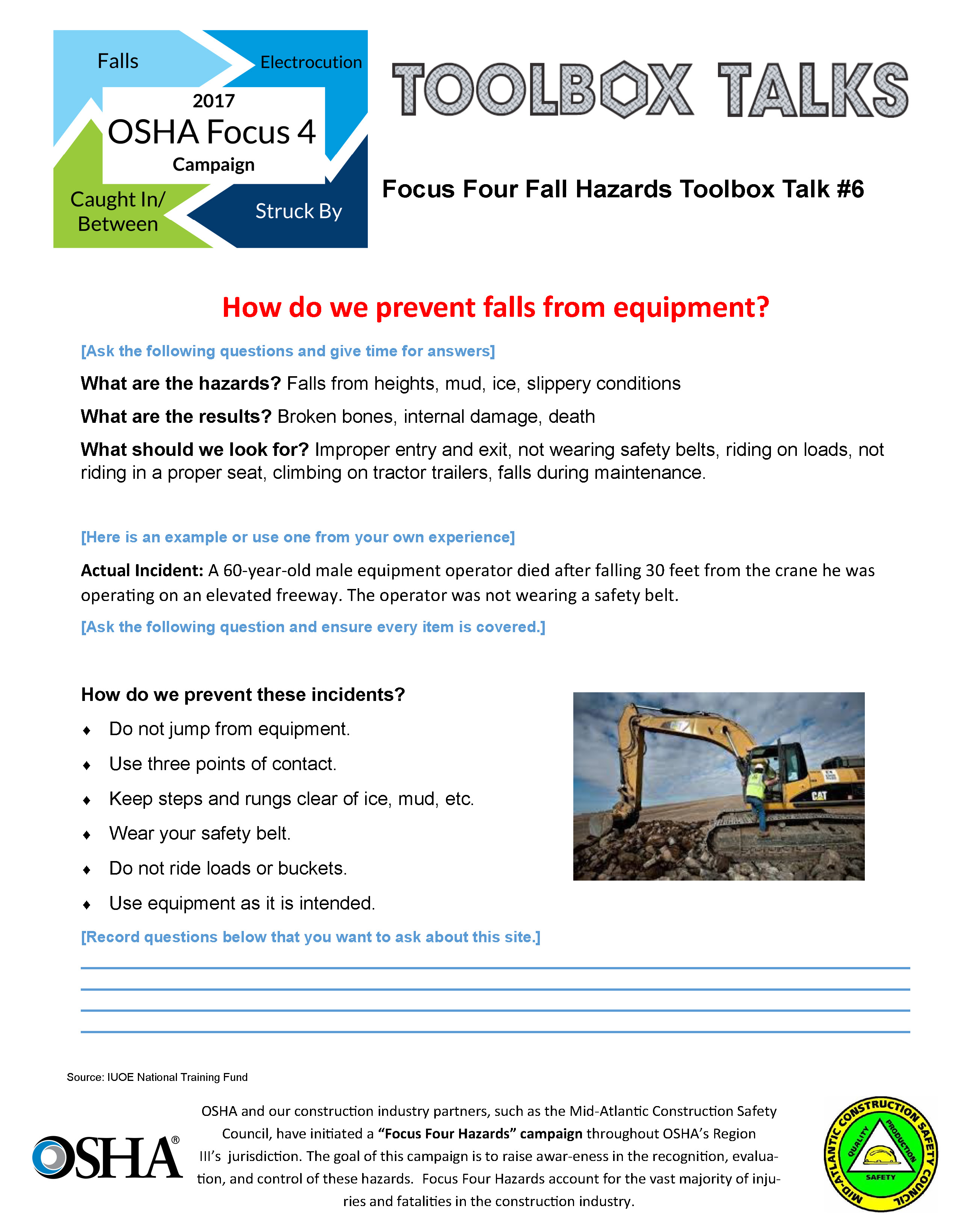
Don’t reinvent the wheel. Leverage proven templates—then customize them.
| Source | Key Features | Best For |
|---|---|---|
| OSHA.gov | Official, compliant, no fluff | Foundational topics, regulatory alignment |
| NIOSH (CDC) | Science-backed, health-focused | Long-term exposure, ergonomics |
| ANSI Safety Standards | Industry-specific guidance | Manufacturing, chemical handling |
| Construction Safety Council | Construction-centric, visual-heavy | Job sites, field crews |
| Safe Site Manager (freemium) | Editable PDFs, sign-off sheets | Teams needing digital tracking |
Always vet third-party PDFs. Remove generic content. Add your site photos, your rules, your emergency numbers.
Common Mistakes That Kill Toolbox Talk Effectiveness
Even the best PDF fails when delivered poorly. Avoid these traps:
1. Reading the PDF verbatim Workers tune out. Use it as a guide, not a script. Ask questions. Encourage stories.
2. Skipping attendance records No signature? No proof. Use the PDF as a legal document. Store completed ones for at least one year.
3. Repeating the same topic monthly Reinforce important ones—but rotate. Pair fall protection with ladder safety, then later with scaffolding.
4. Ignoring worker feedback At the end, ask: “What safety issue should we talk about next?” Use their input to shape future PDFs.
5. Holding talks in noisy or distracted areas Gather in a quiet zone. Turn off radios. Make eye contact.
The PDF enables consistency. The facilitator drives engagement.
Customizing PDFs for Maximum Impact
A one-size-fits-all PDF won’t resonate. Tailor each version:
- Add site-specific photos: Show the actual break room, the real trench work area
- Insert local incident data: “We’ve had 3 near-misses this quarter near the loading dock”
- Translate when needed: For multilingual crews, provide dual-language versions
- Brand it: Add your logo, safety motto (“Zero Harm. Zero Excuses.”)
Customization increases relevance. Relevance drives retention.
How Often Should You Conduct Toolbox Talks?
Frequency matters. Weekly is ideal. Daily for high-risk tasks (e.g., excavation, hot work).
Each session should: - Last 5–10 minutes - Happen before work starts - Be documented via signed PDF
Monthly summaries help spot trends. If 3 talks cover PPE violations and incidents persist, escalate training.
Build Your Own PDF Library—Step by Step
- Choose 12 core topics (one per month, with key ones repeated)
- Download templates from OSHA or industry groups
- Customize with your details, photos, rules
- Convert to PDF with fillable fields for signatures
- Store digitally and print backups
- Train supervisors on delivery techniques
- Review and refresh every 6 months
Bonus: Use a shared cloud folder with version control. Label files clearly: Toolbox_Talk_Fall_Protection_2025_v2.pdf
A safety toolbox talk topics PDF isn’t an administrative chore. It’s a frontline defense. The right PDF turns a routine meeting into a moment of awareness—where someone remembers to check their harness, report a trip hazard, or speak up about a risky shortcut.
Start with proven topics. Build a clean, usable PDF structure. Customize it. Deliver it consistently.
Your workers aren’t just checking a box. They’re taking home actionable habits. And that’s how safety becomes culture.
FAQ
What should you look for in Safety Toolbox Talk Topics PDF Guide for Worksite Teams? Focus on relevance, practical value, and how well the solution matches real user intent.
Is Safety Toolbox Talk Topics PDF Guide for Worksite Teams suitable for beginners? That depends on the workflow, but a clear step-by-step approach usually makes it easier to start.
How do you compare options around Safety Toolbox Talk Topics PDF Guide for Worksite Teams? Compare features, trust signals, limitations, pricing, and ease of implementation.
What mistakes should you avoid? Avoid generic choices, weak validation, and decisions based only on marketing claims.
What is the next best step? Shortlist the most relevant options, validate them quickly, and refine from real-world results.